
Getting to Know MatukuSouth Head Community Comes Together for Bittern Workshop
There is something special about being in a room full of people who already care about a bird that most people will never see.
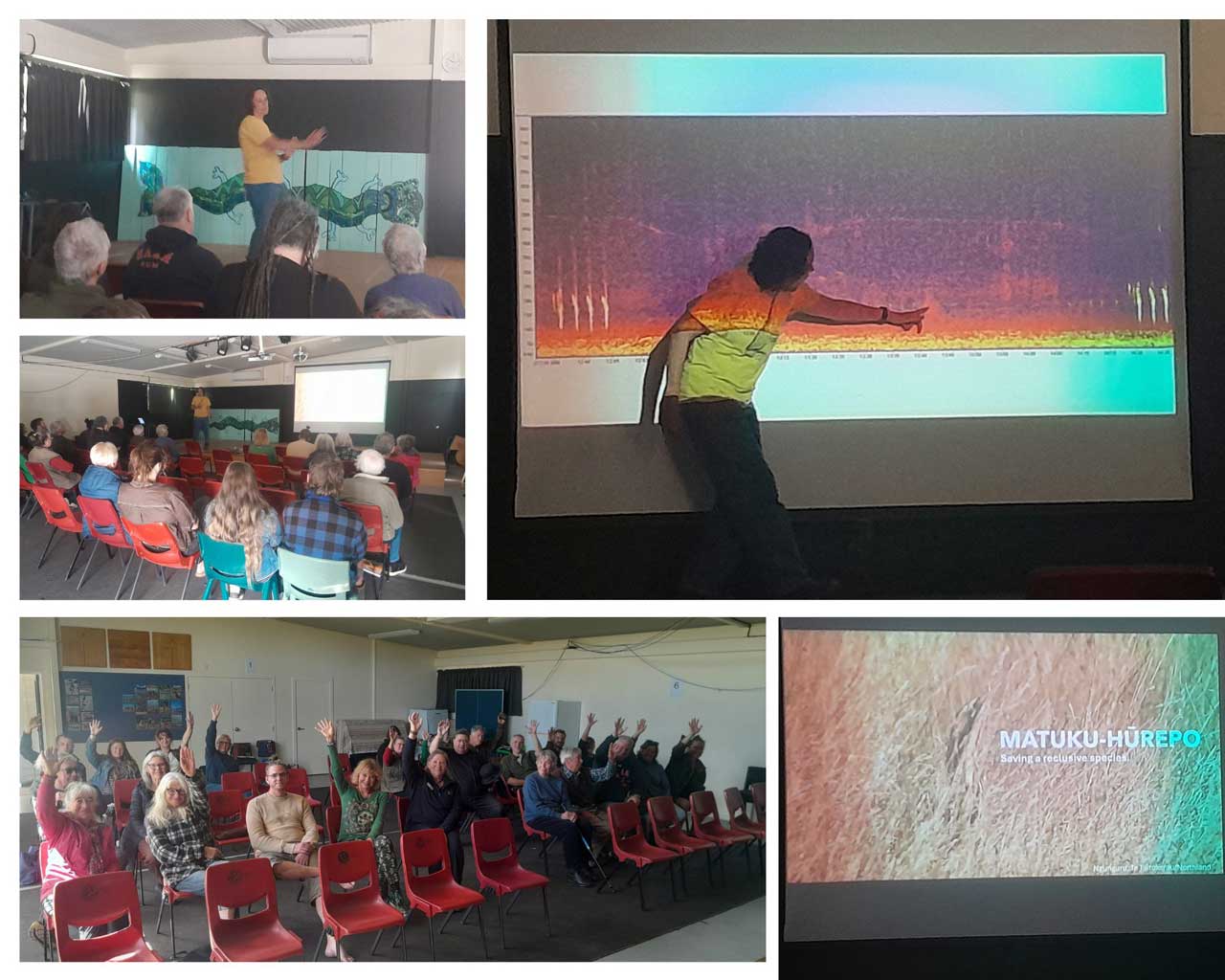
On Sunday, 13 September, 23 locals gathered at Waioneke School in South Head to learn more about one of Aotearoa New Zealand’s most elusive and threatened wetland birds, the matuku hūrepo, or Australasian bittern.
The workshop, hosted by The Forest Bridge Trust, featured an engaging presentation from Wendy Ambury of Love Bittern, who shared her knowledge of these remarkable birds and the work being done to better understand and protect them.
And there was plenty to talk about.
A bird you are more likely to hear than see
Matuku are masters of camouflage. They spend much of their time hidden amongst raupō and dense wetland vegetation, where their streaky brown plumage makes them incredibly difficult to spot.
But during the breeding season, the males give themselves away with their extraordinary booming call, a deep sound that can carry for kilometres across the wetlands.
Wendy explained how these distinctive booms can be recorded and used to monitor where bittern are present and how they are using the landscape. For a bird that is notoriously difficult to observe, acoustic monitoring provides an important way of gathering information without disturbing them.
She also talked about what matuku need to survive, healthy, connected wetlands with plenty of food and suitable vegetation for shelter and breeding.
Their diet is varied, including fish, eels, frogs, insects, freshwater crayfish and other small animals. That makes the health of their wetland environment particularly important. A wetland is not simply a place for a bittern to live; it needs to provide the food and shelter that allow them to survive and raise young.
South Head is an important stronghold
Matuku hūrepo are nationally critical, with fewer than 1,000 mating individuals estimated to remain in New Zealand. They have lost more than 90% of their original wetland habitat, making the remaining wetlands across places such as South Head, the Kaipara Harbour and Tapora increasingly important.
South Head is one of those special places where people still regularly encounter these elusive birds.
At the workshop, one highlight came when the speaker asked the room: “Who has seen a bittern?”
Around 80% of the people raised their hands.
That is a remarkable response for such a secretive and threatened species, and a reminder that South Head’s wetlands are providing habitat for a bird that is disappearing from much of its former range.
But seeing bittern locally should not be taken for granted.
Alongside habitat loss and introduced predators, Wendy spoke about some of the less obvious dangers facing matuku. Vehicle strikes and collisions with power infrastructure are significant threats, particularly around roads such as SH16, Woodhill Road and South Head Road.
For residents, that makes simple actions such as slowing down around wetland areas especially important.
Bitterns don’t recognise our boundaries
The workshop also highlighted just how connected the bittern population is across the wider landscape.
Among those attending was local photographer Bart Wypych, who has been photographing Woodhill bittern for the past three breeding seasons. As someone who spends a lot of time observing these birds, he had plenty of questions for Wendy, adding to the discussion and helping build a shared understanding of the bittern living on our doorstep.
Inia Taylor, another member of the Woodhill conservation community, also attended. Inia has bittern on his wetland and is developing an art project using sculpture to help make these elusive birds more visible to the wider community.
It was a great example of the way conservation work can connect people across property and project boundaries.
When the question was asked whether the bittern seen around Woodhill could be the same birds travelling north towards Tapora, Pouto and Dargaville and vice versa, Wendy’s answer was yes.
Matuku can travel considerable distances between wetlands. Wendy shared the example of a GPS-tracked bittern from the Waikato whose movements covered a surprisingly large area, including journeys towards Tauranga and extensive travel through the surrounding landscape.
This reinforces an important point: protecting a single wetland is valuable, but protecting and connecting wetlands across a wider landscape is even more important.
Local conservation is building that connection
Boyd Steel from Rewild the West also joined the workshop, giving an update on two parallel traplines recently completed across Ōtakanini Tōpū.
Extending from coast to coast, the two traplines act as a virtual predator-control fence, helping create a safer landscape for native wildlife.
Boyd also supplied the baking for the afternoon, an important contribution to any successful community conservation event!
This kind of work is part of a much bigger picture at South Head, where landowners, community groups, mana whenua, government agencies and conservation organisations are working together to protect native species and strengthen predator control.
Technology is also opening up new opportunities. Wendy spoke about work with power companies to reduce the risk of bird strikes around infrastructure, including efforts near Dargaville involving wind farms, powerlines and turbines.
The more we learn about where bittern travel and what puts them at risk, the better equipped we are to make the landscape safer for them.
From learning about matuku to taking action
The workshop also introduced locals to two opportunities to get more involved: the upcoming Great Matuku Hūrepo Muster, a nationwide citizen science project running from September to November, and the Bird of the Year 2026 campaign.
The Matuku Muster is a chance for people to help find and record these elusive birds and their booming calls, adding valuable information to the growing picture of where matuku are living and moving.
And right now, there is another very simple way to help.
Vote Matuku hūrepo for Bird of the Year 2026
Matuku hūrepo is one of Aotearoa’s rarest wetland birds – and one of the most overlooked.
A Bird of the Year vote won’t solve the problems facing our wetlands, but it can help put this extraordinary bird in the spotlight and give people a reason to learn more about the wetlands it depends on.
Voting is open until 5 pm on Sunday, 20 September.
You can vote for up to five native birds, with each bird receiving one point, so there is no need to choose just one favourite.
Make sure Matuku hūrepo is on your list
Then share the campaign with your friends, whānau and anyone who loves our native birds.
Because the more people who know about matuku, the more people who can help protect the wetlands, waterways and connected landscapes they need to survive.
Vote Matuku hūrepo for New Zealand Bird of the Year 2026 and help keep the boom alive.
The Forest Bridge Trust’s South Head project is supporting this community-led mahi, alongside work to protect and enhance the wetlands that provide habitat for species including matuku hūrepo.