

Takatu LandCareNurturing Nature Since 2012
In 2012, a community of conservation enthusiasts came together at a Tāwharanui property with a vision to eliminate animal pests and establish a protective buffer around Tāwharanui Open Sanctuary. Takatu LandCare was soon formed, evolving into an Incorporated Society in 2014, with The Hon Peter Salmon CNZM QC as its inaugural Chairperson.
Takatu LandCare champions the preservation of the natural environment with a geographical area that encompasses the Takatu Peninsula, stretching from the Matakana River to the Whangateau estuary, and is bordered by Tongue Farm Road, Leigh Road, Omaha Flats Road, Broadlands Drive, and the Tāwharanui Regional Park boundary.
John, Lyn, and Yanna from the TLC committee have generously shared with us details on the commendable efforts and positive outcomes of Takatu LandCare’s inspiring community conservation initiative.
What is Takatu LandCare’s main conservation project?
In 2022 TLC commissioned Scrub Growers Ltd to provide an ecological assessment of properties on Tāwharanui Peninsula. Scrub Growers Ltd. identified 15 priority sites across the Tāwharanui Peninsula of ecological importance. These sites were selected based on, ecological connectivity, rare and important habitats, rare and important fauna, habitat diversity, and contributions to ecological processes. The restoration and/or conservation of these sites would not only improve the ecological condition of the site itself but would benefit the surrounding region. In 2023 with funding support from Auckland Council RENH Grant, TLC completed its pilot eco riparian restoration project on one of these identified priority sites, a run-off farm on Whitmore Rd.
TLC wishes to continue creating a network of zones that enable, at a landscape level, native birds to live and move safely around the Peninsula and is currently assessing another site of ecological significance bordering a major upper estuary habitat. If we are successful with our grant application this project will proceed in 2025.
What environmental challenges or issues are you addressing?
Before human habitation most of Tāwharanui Peninsula would have been covered in old-growth podocarp broadleaf primary forest but since these have been burned and felled, much of the district in now covered in manuka/kanuka scrub. The scrubland was initially cleared for pasture, and more recently plantation forestry, and urban settlement, resulting in the expansion of invasive weeds and animal pests throughout the region. Today, this ecological district is highly modified, with the remaining native environments fragmented. While some larger native podocarp forest remnants are present on the Tāwharanui Peninsula, much of the remaining bush areas are regenerating ecosystem types including kanuka and manuka scrub, and broadleaved scrub.
This modified landscape has created a gap in suitable habitat for native birds and deterred the movement of indigenous avifauna across the peninsula. Our objective, and challenge, is to return historic ecological processes and biodiversity functions to the sites in the area, leading to improvements in onsite habitat diversity and species diversity; regeneration and dispersal of indigenous flora and fauna throughout nearby native bush areas; restoration of freshwater streams and ecology, and improvements to ecosystem processes and functions. The aim is to provide a safe haven for the dispersal of native birds throughout the peninsula, a habitat for local fauna to flourish and to improve freshwater quality and ecology of our streams.
Achieving this however requires a commitment from landowners who can visualise the long-term benefits of eco-restoration projects and, in the case of farms, agree to the fencing of streams and bush blocks and the retiring of grazing pasture. This presents a challenge for farmers with a desire on one hand to participate in conservation projects, versus the business economics of running a farm and the capital costs of stock fencing off restoration areas, and for TLC, to ensure the project is viable and able to achieve optimal environmental outcomes.
Predator control was tougher last year, as it was for everyone. Trappers faced challenges in 2023 after the major weather events and a very wet year. Access to land to get to outlying traps, fallen trees on tracks, and muddy dangerous slopes proved challenging, giving some of the predators a reprieve. But trapping momentum is returning to make up for it.
Tell us about your recent successes and achievements.
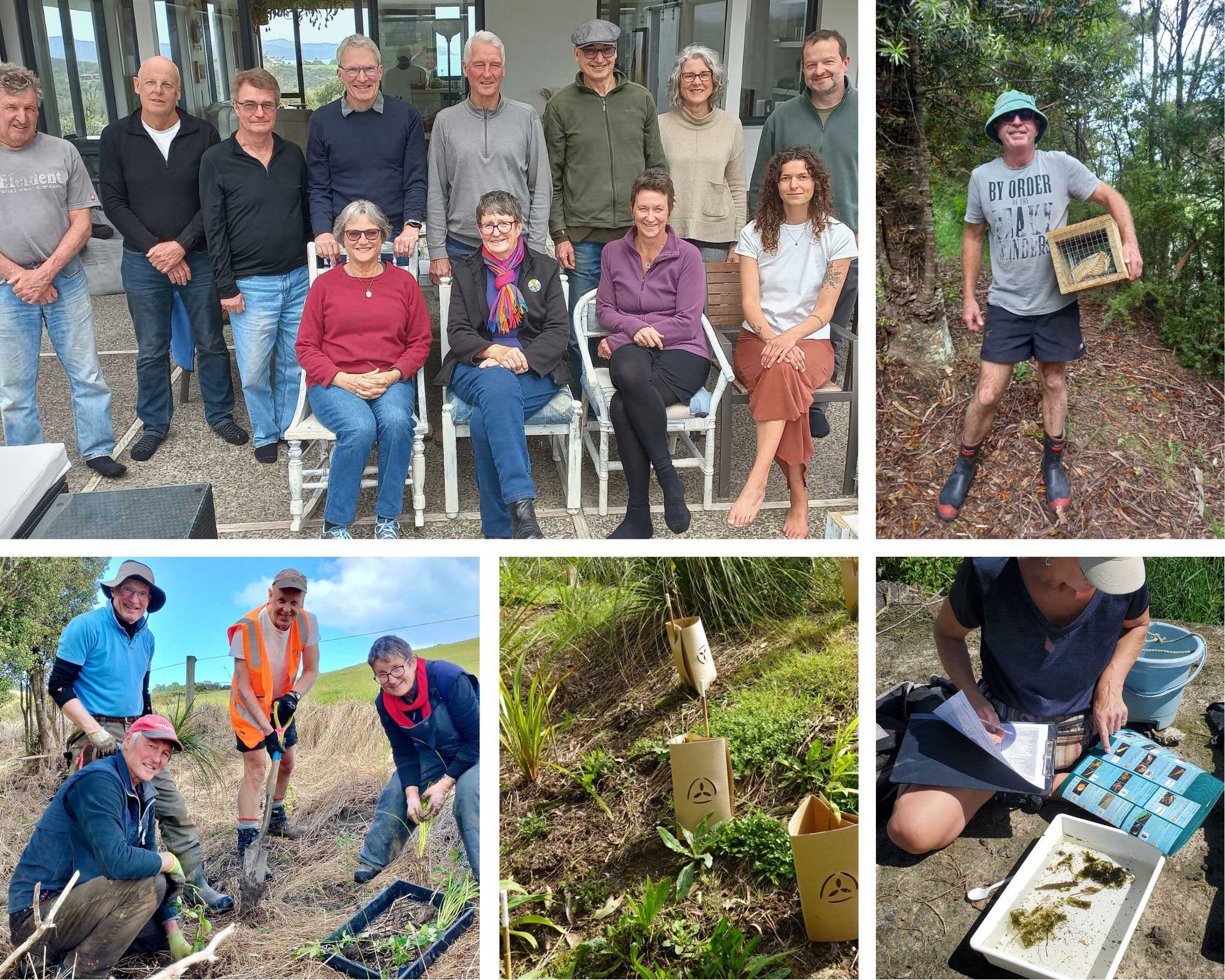
One milestone in 2023 was achieved with our eco-restoration pilot on a run-off farm where 0.95ha for riparian planting along a freshwater stream was successfully undertaken through consultation with the property owners and with Ngati Manuhiri’s support and funding from Auckland Council. 7,400 native plants were planted on two planting days by over 100 community volunteers. This project was successfully implemented by utilising a comprehensive Eco Restoration Implementation Plan prepared by the TLC Committee covering all aspects of the project.
TLC held a pest control seminar at the Woolshed on Tāwharanui. that brought together some key stakeholders in the pest control environment on the peninsula and included a good number of local volunteer trappers. The speakers were inspiring, and everyone valued the opportunity to meet like-minded people seeking the same outcomes.
How many people/volunteers are involved in this community conservation initiative?
The TLC Committee of 10 persons together with our Community Coordinator were all engaged with the preparation of the site for planting, plant selection, planting layout plan, plant placement, and post-planting plant releasing, over several months. Over 100 community volunteers participated in the planting days. To date approx. 700 volunteer hours and 144 contractor hours have been recorded on this project.
How can people get involved and support Takatu LandCare?
Join as a member through our website: Takatu LandCare – Community Conservation Group. If you are keen to set up a trapline or discuss an eco-restoration project on the peninsula Contact our Community Coordinator – Lyn Hamilton Hunter. Follow and like us on Facebook.