
Connecting for PekapekaInsights from the 2026 National Hui
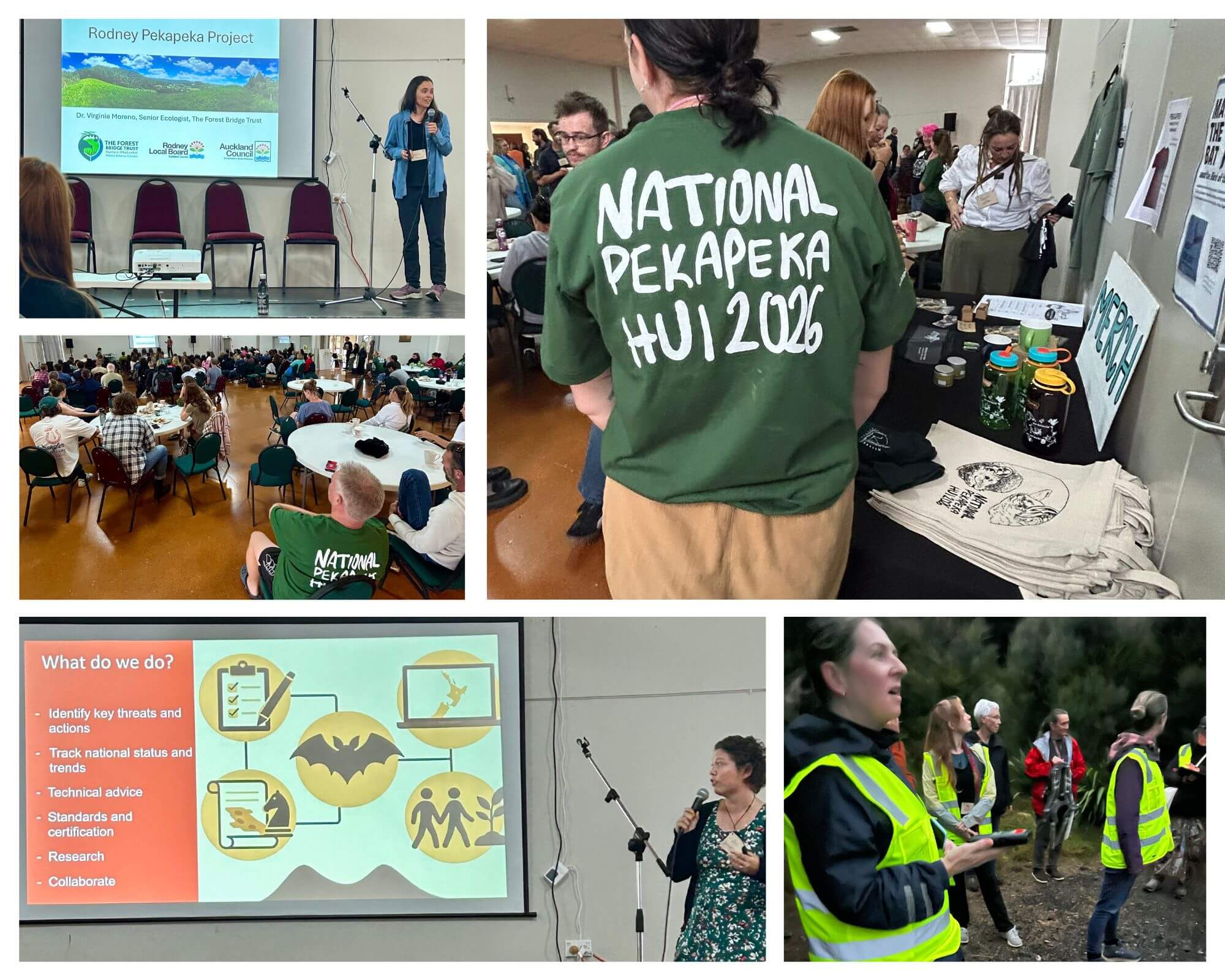
Last month, four Forest Bridge Trust team members attended the 2026 National Pekapeka Hui in Franklin with over 180 participants from Aotearoa. Ecologists, iwi, funders, community groups, and volunteers gathered to connect, learn, and unite around protecting our native pekapeka.
We were especially proud to support our own ecologist, Virginia Moreno, who is leading the Rodney Pekapeka Project. Virginia presented early insights from the project, highlighting both the exciting potential ahead and the importance of building a strong foundation of data and community involvement from the outset.
The 3 day hui opened with a series of presentations showcasing the breadth of pekapeka projects happening across the motu. Highlights included the Finding Franklin Bats project, a great example to us all of a successful, community-driven pekapeka project, alongside inspiring updates from EcoQuest, Forest & Bird (Te Hoiere Project), Pukanui Forest Trust, and Catlins Bats. Together, these initiatives demonstrated the power of collaboration, long-term commitment and local knowledge in protecting our native bat populations.
It was an invaluable opportunity to hear directly from iwi about the significance of pekapeka in te ao Māori, Edith Tuhimataas explained that bats are a symbol of duality, representing both the physical and spiritual realms.
We were also introduced to innovative conservation tools and approaches, from the latest in acoustic recorders to bat detection dogs trained to locate roosts. Day 1 concluded with a lively bat quiz that combined learning and laughter, followed by a guided bat walk. While only a handful of bats were detected, the experience reinforced just how elusive these remarkable creatures are and how important ongoing monitoring is to better understand their presence and behaviour.
The following 2 days were packed with fascinating research and practical insights.
One standout presentation from Nicolas Ling explored the effects of artificial illumination and light spectrum on long-tailed bat activity. The map he presented was particularly eye-opening, showing the extent of the artificial lighting corridor now stretching from Auckland through Hamilton to Tauranga. As LED lighting becomes more widespread, its brighter, whiter light, closely mimicking daylight, may create barriers or confusion for migrating species, adding another layer of challenge for pekapeka survival.
We also had the chance to build our own Griff Mini bat detectors, simple, low-cost devices that plug into a phone and allow real-time bat detection. With components costing between $20–$40, these accessible tools have huge potential for expanding community-led monitoring. Safe to say, there are a few night walks now firmly on our team’s agenda!
Practical habitat insights were another key theme. Arborist and bat enthusiast Fredrik Hjelm shared the importance of retaining older trees and the potential to create bat roosts using carefully placed chainsaw slits, a simple but effective way to support bats in modified landscapes where natural roosts are limited We also heard from Ian Davidson-Watts about the use of sound lures to improve bat capture rates. Research showed that New Zealand native bat social calls were more effective than European bat calls, though both significantly increased detection compared to using no sound at all. It’s a strong reminder of the value of locally informed research.
Looking Ahead for Rodney
Across the three days, one thing was clear: while there is a deep and shared commitment to protecting our native pekapeka, both long-tailed (Chalinolobus tuberculatus) and short-tailed (Mystacina tuberculata), there is still so much more to learn.
Key threats remain consistent across the country, including predation, habitat loss, artificial light pollution and infrastructure such as wind farms. Addressing these challenges will require ongoing research, strong collaboration and long-term funding.
For us, the Hui reinforced that the Rodney Pekapeka Project is still in its early days, but the potential is immense. With collaboration, community participation and sustained investment, we can build a clearer picture of pekapeka populations in our region and take meaningful action to protect them.
We left feeling inspired, connected and more motivated than ever to support the future of Pekapeka across The Forest Bridge.
Ngā mihi nui to the Rodney Local Board and Auckland Council for supporting our team to attend and continue this important mahi.