

Looking after local rivers– Friends of Awa Matakanakana Catchment
The “Friends of Awa Matakanakana Catchment” is a local community group committed to the preservation and enhancement of the Awa Matakanakana catchment area.
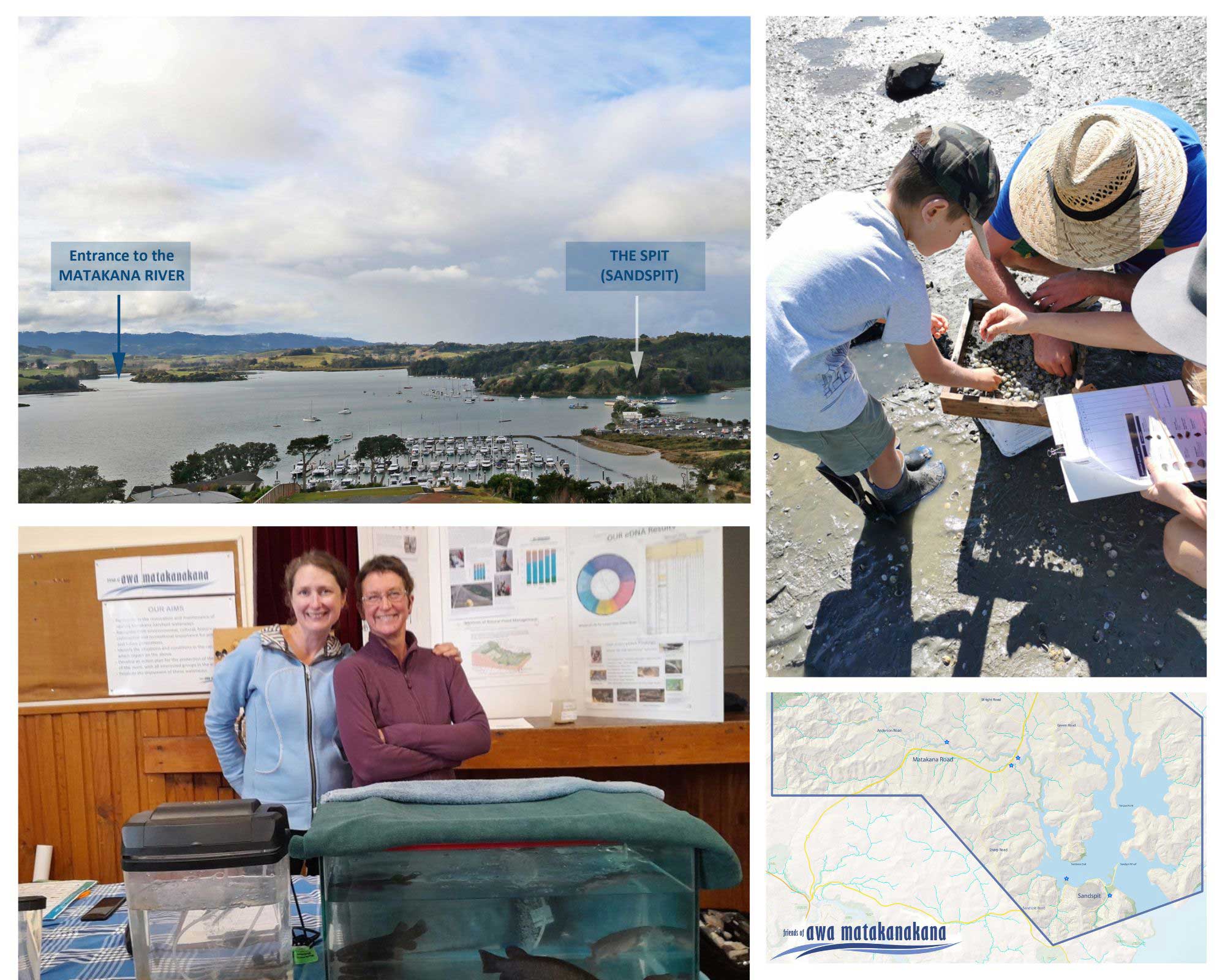
With a focus on the Sandspit estuary and the two rivers that feed into it, the Glen Eden and Matakana rivers, the group’s mission revolves around safeguarding the fragile ecosystem, as well as promoting the cultural, historical, commercial, and recreational importance of the wider catchment.
Comprising of volunteers, environmental advocates, and concerned citizens, the Friends of Awa Matakanaka undertake water quality and sediment monitoring, inspections of macroinvertebrate species, the presence of fish and koura, habitat loss, and invasive species encroachment.
Through collaborative efforts with Auckland Council, Rodney Healthy Harbour Fund, and neighbouring communities, the group has implemented a variety of initiatives aimed at restoring the catchment’s natural balance.
FOAM is a great local conservation project to get involved with and engages in a range of activities, including shellfish monitoring sessions, planting days, clean-up campaigns, public meetings, and community events. By developing a sense of stewardship among community members, FOAM encourages active participation and understanding of the catchment’s ecological intricacies.
Vice-chair Martin Evans took time to tell us more about what FOAM does and how people can get involved.
Which Rivers do FOAM monitor?
The main rivers are the Glen Eden which flows from Dome Forest to Sandspit and the Matakana River which flows from Mt Tamahunga to Sandspit. Collectively they are known by Ngāti Manuhiri as AwaMatakanakana, hence our name. There are a lot of smaller streams we also monitor within 58 ㎢ of the catchment.
When was FOAM set up, by whom and why?
FOAM was established by John Collins, Jo Haswell from Rainbow’s End and some other Sandspit residents in 2018 with a focus on reducing the sediment coming down the rivers, detecting and preventing pollution and enhancing community enjoyment of the rivers. FOAM’s stated objective is “To participate in the restoration and maintenance of healthy Matakana-Sandspit waterways and those situations and conditions in the catchment which impact on this, recognising their environmental, cultural, historical, commercial and recreational importance for present and future generations”.
What happens to the data?
We monitor 11 sites on a quarterly basis as it is very important to get a set of data to assist in characterising and understanding the river behaviour. All of FOAM’s water quality monitoring data is loaded into the public Auckland Council WaiCare database. We monitor physical condition (temperature, visual, flow, velocity, depth etc), chemical (pH, Dissolved Oxygen and sometimes conductivity if an instrument is available), nutrients (nitrate, ammonia and dissolved reactive phosphorus), macroinvertebrates and fish present (in freshwater sites) and E.Coli bacterial concentrations (as a measure of the level of mammalian contamination). The data is collected by teams of around 2 to 3 people depending on availability on the day and is mostly analysed by Martin Evans. The aim is to develop trends for each site, flag seriously contaminated sites with the Auckland Council pollution hotline and assess in the long term how river improvement works are influencing water quality status. All sampling is compared with the National Policy Statement for Freshwater Management (NPS-FM) “bottom line “guidelines.
How much of the Matakana River does FOAM monitor?
Our target has been to monitor at least one site in the uppermost parts of the catchment and one in the lower for freshwater and similarly for the 4.5 km saline sections of each of the main rivers plus monitor selected streams in the catchment as volunteer time and landowner access permits. The saline sections are more complex in that we have currently lost the use of the riverboat for the lower sections.
What have been the findings from the past few years regarding the health of local rivers? What species have been detected?
Over the past 4 years, there is a decline in water quality across many sites for most parameters. Some streams are permanently in a very very poor condition. The eDNA result was a one-off and we hope to repeat it in one year. Currently, the only conclusion one can draw is the presence /absence and the overall level of biodiversity. We detected over 50 specific species but many other generic genus and classes. The standout findings were the presence of Hochstetter frogs, freshwater mussels and short jaw Kokopu in the Glen Eden river plus giant Kokopu and Koura in the upper Matakana. Bullies were present in most locations. Long-fin tuna (eels) were surprisingly present at all sites. FOAM also independently check other macroinvertebrates which are currently not picked up by the eDNA sequencing database including freshwater limpets, the only limpet species in the world that glows in the dark!
Why is it important to monitor local shellfish?
We learn what types of shellfish species exist and where on the Spit and in the estuary, they are located. We measure the size of the cockles and count the numbers of all shellfish. This allows an annual assessment of the total cockles present and their maturity and is a direct measurement of the health of the estuary. Whilst the numbers of smaller cockles are higher as a percentage there is a significant and rapid decline in large mature cockles (over 20 mm in width).
Why should we be concerned about sediment in local rivers?
Sediment causes many serious impacts on river systems as well as affecting the wider floodplain biology. Excessive sediment prevents light from entering the rivers, reduces visibility for fish to feed, reduces oxygen in the river, smothers biota living in the base of the stream, causes significant damage to infrastructure and as it passes downstream fills estuaries and is one of the leading causes of shellfish and degradation of the coastal marine environment. The sediment from the Awa Matakanakana system is causing the filling of Sandpsit estuary, changing the prevalence of mangroves, contributing to reduced maturation of shellfish and significant changes to Kawau Bay caused by smothering. FOAM is identifying excessive sediment sources, and the behaviour of sediment in the river with differing rainfall events and has a number of currently unfunded proposals to track and measure sediment through the system.
Who can volunteer?
All are welcome please contact awamatakanakana2@gmail.com.
Can children and young people get involved?
FOAM’s shellfish monitoring day is an easy family-friendly event to help children understand their wider environment. Families are welcome to get involved with water quality sampling. Come with an inquiring mind and good observational skills. We can provide all training and equipment for water quality testing thanks to continuing support from WaiCare.
What other projects does FOAM participate in?
FOAM train and support other community groups in water quality sampling. We undertake riparian planting and support fencing in very selective locations as Auckland Council and Rodney Local Board grants allow. The locations are selected based on the sustainability of the planting and the likely sediment mitigation we can achieve. We undertake a lot of research into the best options for water quality improvement. We have recently completed a trial of a specialist turbidity instrument in the Matakana River which can measure the clarity of the river every 5 minutes. This provides a real-time understanding of river behaviour. We want to extend the trial to include rain and river gauges in both the Matakana and Glen Eden catchments and install a second turbidity instrument in the Glen Eden River.
Examples of how you can help FOAM :-
- A day per 3 months—Water quality sampling
- An hour a fortnight cleaning sensors
- Come one/two days a year to create wetlands
- A couple of hours a year to check on our shellfish