
Listening for Flying GoatsWhat We’ve Learned from the Tītī / Cook’s Petrel Monitoring Survey
Late last year, The Forest Bridge Trust was proud to lend a hand to the New Zealand Seabird Trust on a special summer citizen-science project, one that asked a simple question with a remarkable answer: where do tītī / Cook’s petrels travel at night as they cross the mainland?
The call to action was easy. You didn’t need binoculars, specialist knowledge, or even to see the birds. All we asked was that people step outside after dark, listen carefully, and share what they heard or saw. Every call, fleeting silhouette, or faint hum of wingbeats mattered.
And the community delivered.
A hidden flyway revealed
Every summer night from October to January, thousands of tītī / Cook’s petrels take an extraordinary shortcut across the Auckland–Northland Isthmus. Under the cover of darkness, they fly between the Tasman Sea and their breeding grounds on Te Hauturu-o-Toi / Little Barrier Island — home to an estimated 2–3 million breeding birds.
Their distinctive “kek-kek-kek” call has earned them the unforgettable nickname “flying goats”. Once you hear it, you never forget it.
This summer’s survey has helped shine a light on a flyway that, until now, was largely undocumented.
An extraordinary community response
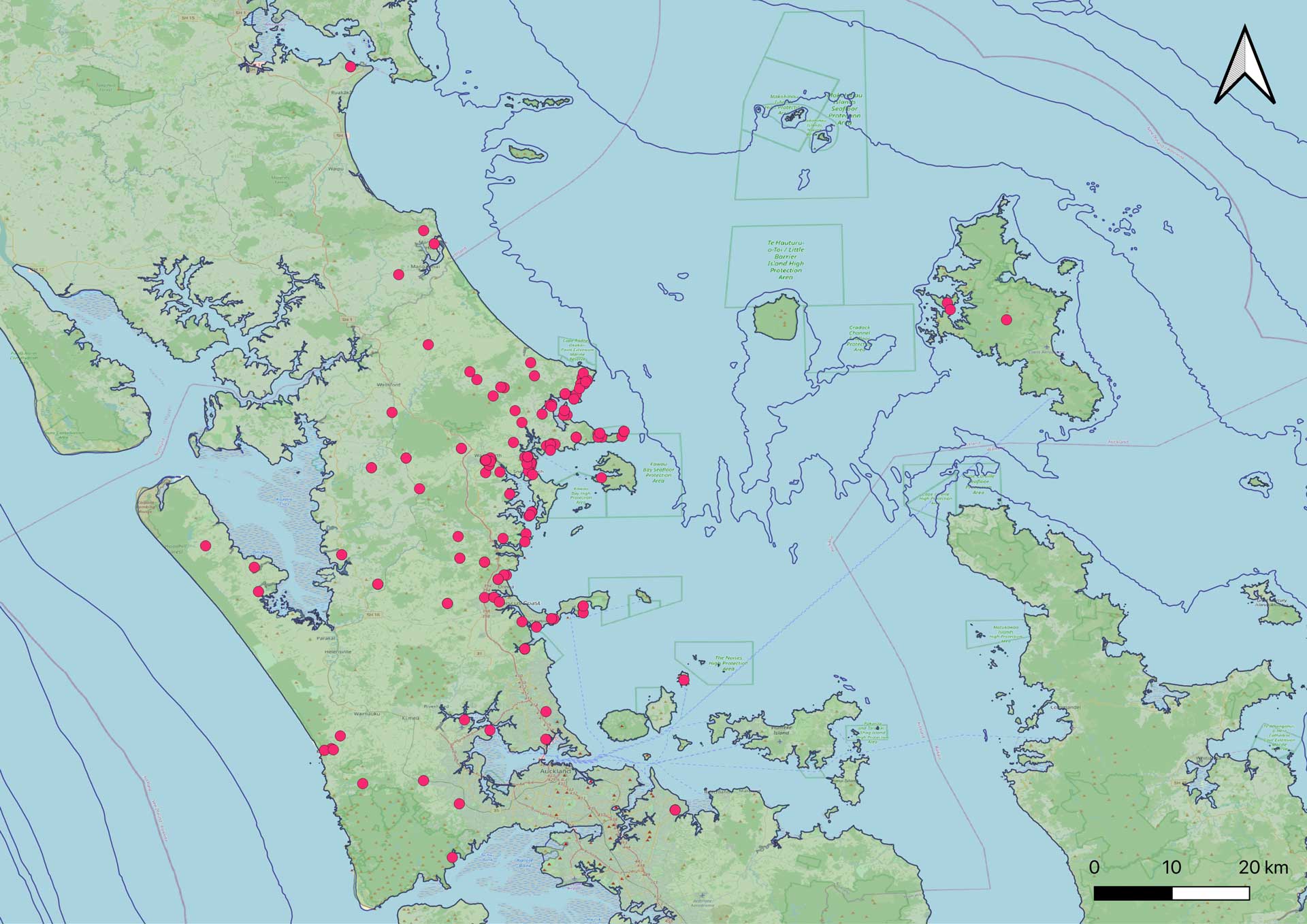
In just over a month, more than 200 reports were submitted from across the region. Observations came in from coastal locations like Muriwai, South Head, Mangawhai, Leigh, Snells Beach and the Tāwharanui Peninsula, as well as inland communities including Warkworth, Matakana and Silverdale.
Even more special were the stories behind the data.
One person described lying on their back at a music festival, watching tītī silhouettes flick past against low mist gently lit by lights below. Another heard their calls drifting overhead during a concert in Matakana, the birds seemingly unfazed by distant light shows and the thump of bass.
Others shared quieter moments, hearing tītī while soaking in a hot tub, brushing their teeth with the window open, or lying in bed trying to fall asleep. One long-time resident told us, “We’ve lived here for 20 years and always wondered what those goat-sounding birds were.”
Together, these everyday moments have become valuable conservation data.
Why these observations matter
By pooling community observations, the Seabird Trust can now begin to map this important nocturnal flyway in detail. The information is helping identify areas where birds , especially young fledglings, may be vulnerable to artificial lighting, disorientation, or other human impacts as they cross our towns, farms and rural landscapes.
It’s a powerful reminder that extraordinary wildlife behaviour is happening right above our homes every summer night — often unseen, but not unheard.
You can still take part
If you’ve heard tītī this summer, we’d still love to hear from you. No experience is needed — just a quiet moment outdoors after dark and a willingness to listen.
Submit your observations here: https://forms.gle/Hzg95g9sB4SKkqkAA
Reports so far have come from Mangawhai Heads, Ti Point, Pūhoi, Millwater, Great Barrier Island, Tāwharanui Peninsula, Mahurangi East, Muriwai, Leigh, Swanson, South Head, Warkworth, Upper Waiwera, Snells Beach, Howick and Northcote — with several repeat sightings. We’re especially keen for observations further west and across rural Rodney.
Please share the survey with whānau and friends, the more ears on the ground, the clearer the picture becomes.
About tītī / Cook’s petrels
Tītī are small grey-and-white petrels with narrow wings and pointed tails, grey heads, darker “M”-shaped markings on their wings and rump, and white underparts with a thin dark underwing line. They have black bills, dark eyes, and blue-grey legs with yellowish webs.
They fly vast distances each night between the Tasman Sea and the Hauraki Gulf and are currently classified as nationally vulnerable. Every observation helps build the knowledge needed to better protect them.
So next summer evening, if you hear a mysterious “kek-kek-kek” overhead, you’ll know the flying goats are on the move. And you’ll know that simply listening can help protect them.