

5-Minute Bird Count Course
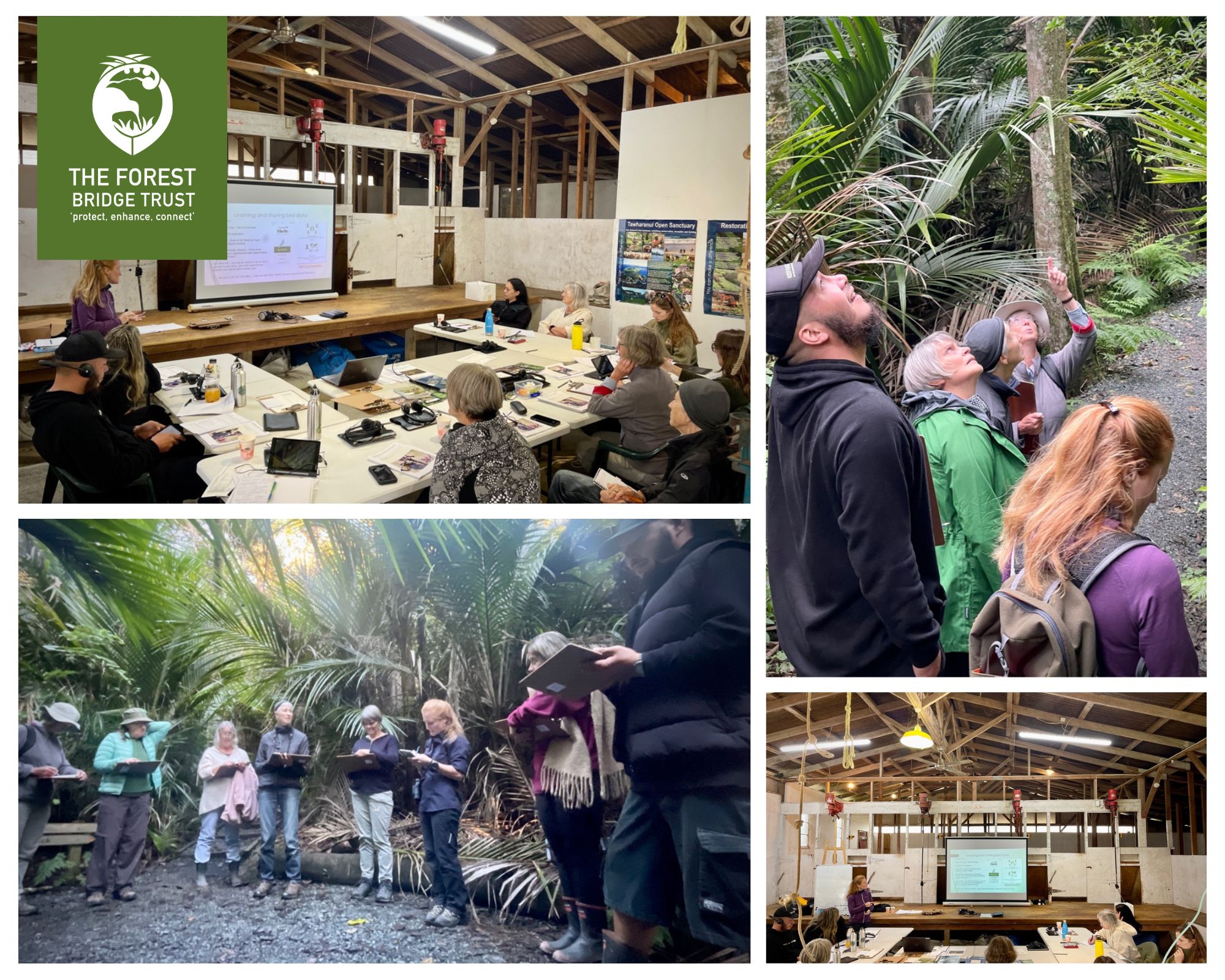
Two of our team Anne Ginders and Elena Suin were able to attend a 2-day 5-Minute Bird Count course in June. This was a unique opportunity to experience the proliferation of species that can only survive in a sanctuary such as Tawharanui and gain a better understanding of just how many birds New Zealand has lost to predator species. Anne Ginders gave us an account of the 2-day course.
Who started the 5 Minute Bird Count Course and why?
The 5-Minute Bird Count (5MBC) technique devised by David G. Dawson and P. C. Bull and first published in “Notornis” the journal of the Ornithological Society of New Zealand in 1975 has become the national standard. It is taught to anyone who will be gathering data within a forest location/environment for scientific purposes.
How long is the course?
It is taught over two days. Day one is background and theory and day two is assessment followed by a practical assessment in the forest.
Where was it held?
This course was held in the Tawharanui Sanctuary Reserve DOC classroom.
What did you learn?
The course is designed to teach the method.
5MBC is a nationally consistent method designed to monitor bird populations in a forest habitat. It is an easily repeatable, cheap, and simple method used to assess the long term status of bird populations. It can be used in any forested location to monitor multiple bird species at one time which makes it very time efficient.
The method captures trends in relative abundance, simple indices and the presence and absence of species to compile bird lists. The data is compiled in a national database administered by DOC.
How was the course different from the online training anyone can do?
The course is a unit standard that must be assessed and signed off by a qualified DOC trainer.
Was it all theory or were you out in the field listening too?
The two days are quite different. Day one is all theory and case studies taught as a PowerPoint with a supporting handbook and Assessment booklet. There is a practice module recorded on a tablet with headsets. Day two is learning how to implement the technique in a forested environment.
Did you learn calls?
Yes! I have never heard Saddleback/Tieke, Whitehead/pōpokotea, Kokako, or Bellbird/Korimako in the wild before. Learning to tell the difference between Tui and Korimako was the toughest challenge.
What birds did you identify?
Tui, Korimako, Tieke, Blackbird, Eastern Rosella, Piwakawaka, Kereru, Popokotea, Starling, Sparrow, Pukeko, Robin, Waxeye/Tauhou