
Matu Kōkako TranslocationA journey for kōkako

The recent translocation of 20 kōkako from the Hunua Ranges to Mataraua Forest was a significant conservation effort, bringing together mana whenua, conservation groups and volunteers. Matu Booth, Conservation Manager at The Forest Bridge Trust, was involved in the translocation and shares insights into the Trust’s role in this collaborative effort and what it means for kōkako conservation.
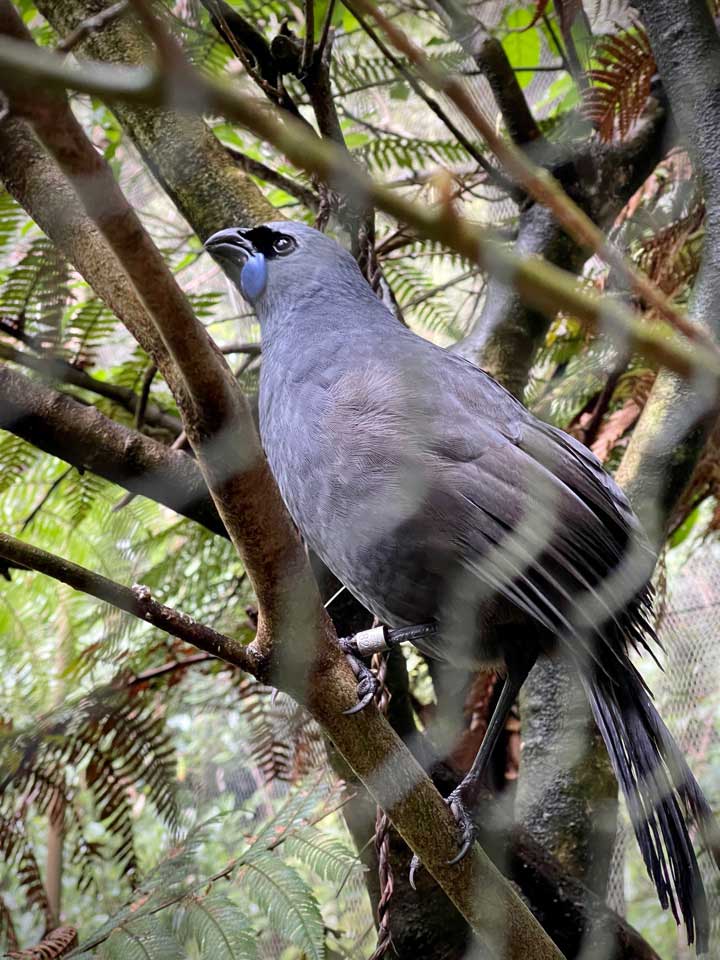
Kōkako occupy a special place in our imagining of what a thriving New Zealand forest might look and sound like. They are our largest remaining forest songbird and are most often glimpsed as they bound or glide through the upper canopy. They belong to the same family as the extinct huia, and like the huia, they are move around their territory and feed conspicuously as a pair.
But it is their song that really stops us in our tracks. Coming from high in the canopy while the forest is still shrouded in the dim light of dawn, a kōkako’s eerie swooping notes can seem to come from everywhere and nowhere at once. It is little wonder that kōkako are identified by so many community conservation groups as the species they would ultimately love to see returned to their forests.
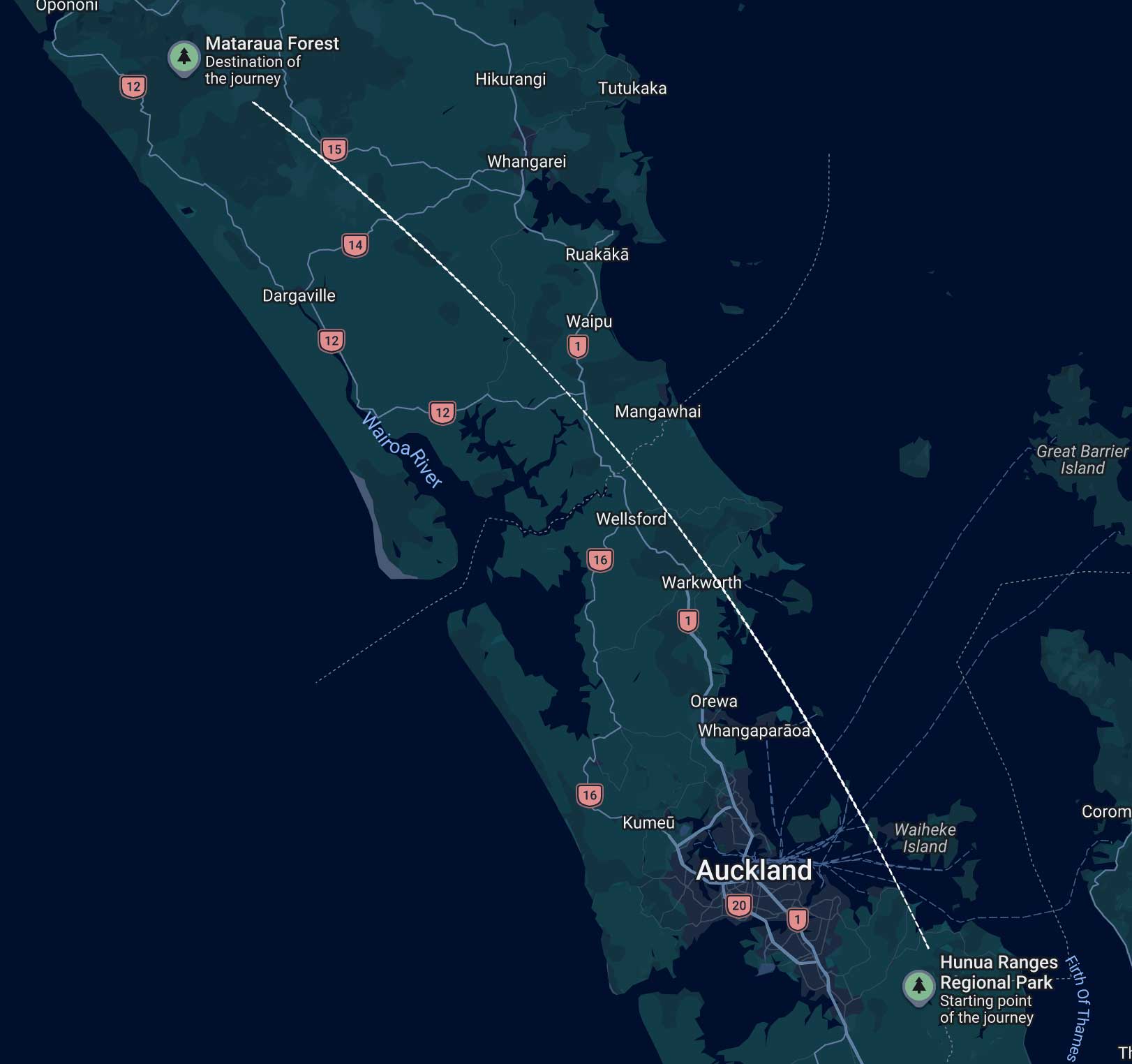
In late August, 20 kōkako were gifted by five mana whenua iwi Ngāti Pāoa, Ngāti Tamaoho, Ngāti Tai ki Tāmaki, Ngāti Tamaterā and Ngāti Whanaunga to Te Roroa of the southern Hokianga. Their destination was Mataraua Forest, northeast of Waipoua Forest (home of Tāne Mahuta and some of our most iconic kauri).
From the Department of Conservation’s perspective, the translocation was part of an effort to return kōkako to a forest where they had once been well established. Mataraua is at the northern limit of the species’ range and has historically been an important source population for kōkako translocations elsewhere in the north.
The story of the Mataraua population has had its highs and lows. By 1994 the population was reduced to just two breeding pairs. Sustained predator control eventually allowed the population to recover to the point where, by the late 2000s, Mataraua was sufficiently robust to become a source site for other translocations.
But without sustained pest control the population subsequently crashed again and without the emergency translocation of birds from Hunua, it would have faced extinction.
Catching a kōkako
The translocation involved a revolving catch crew made up of iwi, volunteers and staff from Auckland Council and DOC. Catching kōkako is a carefully prepared operation requiring plenty of patience, good bush skills and a fair amount of ingenuity.
Before the catching began, potential territories were surveyed to identify pairs and suitable capture sites. The sites then had to be prepared so that 12-metre-long mist nets could be raised into the canopy.
Getting those nets into position is a job in itself. A slingshot is used to send a small weight and line over a selected branch. That line is then used to pull a heavier cord over the fork in the branch. The ends of the cord are joined to form an endless loop, with a loop positioned at either end of the net site. The catch crew can then attach multiple nets to the loops, creating a vertical wall of almost invisible canopy netting that can be raised and lowered smoothly.
It is a lot of work for what can sometimes be a very modest return. A carefully prepared site might produce one pair of birds. If the net happens to sit near the boundary between territories, the playback calls may attract a neighbouring pair as well.
In the best circumstances, both birds of a pair fly into the net together. Sometimes the calls are alternated between speakers positioned on either side of the net, encouraging a bird to cross and recross the clearing in search of the unseen bird it can hear.
Once caught, each bird was carefully disentangled, measured, weighed to confirm its sex and banded before being transported to the holding aviaries. Mist-netting was completed by around midday each day, giving the birds plenty of time to settle into their aviaries and start to feed before nightfall.
Life in the aviary
My role was to care for the birds during their brief stay in captivity between capture and their transfer north.
The main holding aviary might not be quite what you imagine when you picture a specialist wildlife facility. It was, in fact, an old family tent that had been modified into four small holding compartments, separated by floor-to-ceiling shade-cloth partitions and doors. That rather unassuming tent has been an important piece of DOC’s translocation equipment for many years.
Before the birds arrived, branches of favoured kōkako food plants and suitable perches were arranged throughout the compartments, creating a sheltered and subdued environment in which the birds could settle.
Kōkako are relatively straightforward to care for during a short period in captivity because of their wonderfully varied diet. They are known to feed on more than 80 species of plants, along with a range of invertebrates. Most birds begin feeding on the vegetation in their aviary within a few hours of being captured.
They were also offered supplementary food, including a range of fresh fruit and vegetables and specially formulated liquids.
Much of my time was spent crouching quietly beside the aviary, peering through the shade cloth to check that each bird was feeding, moving normally and settling into its temporary surroundings. It was not particularly glamorous work, but it was an important part of making sure the birds were in good condition for the next stage of their journey.
The most potentially stressful part for the birds came when they had to be recaptured and placed into their transfer boxes. To make this process as straightforward as possible, I removed as much of the vegetation as I could late in the day, leaving the aviary easier to work in once darkness fell.
We then used red-light head torches to locate and capture the roosting birds by hand. They were inevitably startled for a moment, but the technique was quick and considerably more efficient than trying to catch them during the day, when they would be alert, active and much more interested in what was happening around them.
North to Mataraua
The drive north to Mataraua took around four and a half hours. By the time the birds and their small entourage of carers arrived at the local marae, it was around midnight. Both birds and humans were warmly hosted there until dawn.
At first light, the transfer boxes were carried to the release site.
The birds were blessed with prayers and waiata before the moment everyone had been working towards arrived. The doors of the boxes were lifted and, one after another, the kōkako bounded out and disappeared upwards into their new forest.
It is a deceptively simple moment after all the planning, preparation and hard work that has gone before it.
A bigger conservation story
As with any wildlife translocation, there is a profound responsibility involved in capturing and handling individual animals and disrupting their lives for the purpose of establishing or strengthening populations elsewhere.
The history of the Hunua kōkako population shows why that effort can be worthwhile.
In 1994, the Hunua population had declined to just 23 birds, including a single remaining female. Thirty years of targeted predator control, translocations and careful genetic management have produced an extraordinary recovery. The 2025 survey recorded 418 breeding pairs, making Hunua currently the largest single kōkako population.
Hunua Pairs Dueting
The hope is that the recent transfer will contribute to a similar trajectory of recovery in Mataraua and Waipoua – forests where kōkako have previously flourished.
There is also an intriguing complication to re-establishing kōkako in forests where other kōkako already live — and it comes back to those unforgettable songs.
Kōkako have remarkably complex vocalisations, and birds from different forests develop distinctive local vocabularies and dialects. These differences can initially influence how birds recognise and choose potential mates, creating something of a temporary barrier to integration into an existing breeding population.
Kōkako Song #1
Kōkako Song #2
Fortunately, the dialects of translocated birds appear to change over time, while the next generation loses many of the most distinctive features of their parents’ original calls. Interestingly, this temporary difference in song and pair preference may also influence the way genes become mixed within a newly established population.
What happens next?
The translocated birds are not carrying transmitters, but they have been individually banded so that they can be recognised during future monitoring.
The real test of the translocation will come when the population is surveyed again. This involves moving through the release area and playing kōkako recordings to attract the birds, then following them to identify their individual band combinations and determine whether they have paired up and established breeding territories.
For now, the birds are somewhere up there in the forest, getting on with the business of being kōkako.
If the monitoring results are encouraging, another 20 birds are likely to make the journey next year.
And perhaps, in time, the forests of Mataraua will once again ring with that unmistakable dawn chorus — a sound that tells us that something very special is thriving high above our heads.